Battle Of The Sexes: Who Ages Better - Men Or Women?

The answer to this 'age old' question is far from simple. In fact, it’s quite complicated and nuanced.
There are a number of factors that come into play, including biology, lifestyle, and societal expectations.
That said, there is considerable research that suggests that men may indeed age better than women.
For example, one study found that men tend to suffer less from age-related conditions such as arthritis, osteoporosis, and Alzheimer’s disease.
Some suggest that men become more distinguished (and attractive) as they age, whereas women start to look more 'jaded'. It's probably why I personally find older men more attractive.
So what does this all mean? Are men really aging better than women? And if so, why? Let’s take a closer look at the evidence.
(PS feel free to leave your own comments at the foot of this article!)
Society's Perception Of Older Men and Women
It is no secret that men and women age differently. However, women are often bombarded with messages about how they need to fight the aging process, while men are largely left to their own devices.
To many that seems a little unfair - so do men have less to worry about as they age?
Women tend to show signs of aging sooner than men, due to a variety of factors including hormonal changes, stress, lifestyle choices, and genetics.
However, do women look after themselves better?
While some may say that men age like fine wine, others may argue that women take better care of themselves.
There's no question that women spend a lot more money on beauty products than men. (although that market is changing over recent years).
They are also more prone to take better care of their hairstyles. But ultimately, it comes down to individual circumstances and how well each person takes care of themselves as they age.
Another factor that may play a role in how well men and women age is lifestyle choices.
Women tend to live longer than men, even when controlling for factors like smoking and obesity
This difference may be due in part to lifestyle choices such as taking care of one’s health and making regular doctor appointments.
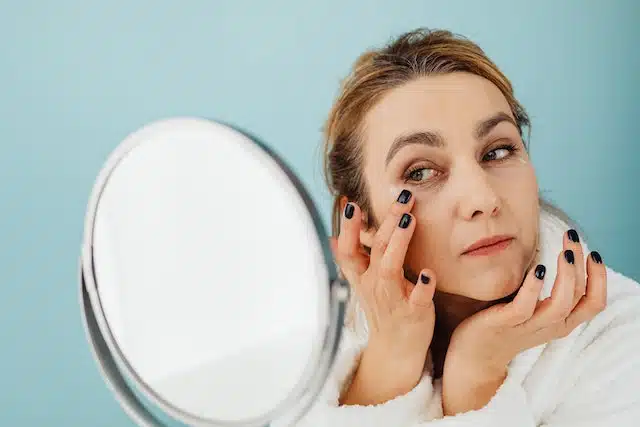
What Are The Different Types of Aging
As we age, our bodies go through many changes. Some of these changes are more noticeable than others.
For example, wrinkles and gray hair are two common signs of aging that we can see on the outside. But there are many other changes that happen inside our bodies as we age.
There are two main types of aging: intrinsic and extrinsic.
Intrinsic aging is the natural aging process that happens to everyone as they get older. Extrinsic aging is caused by external factors, such as sun exposure and smoking.
Intrinsic aging starts in our 20s and continues throughout our lives. Some of the changes that occur during intrinsic aging include:
Wrinkles: As we age, our skin becomes thinner and less elastic. This causes wrinkles to form, especially on sun-exposed areas of the body such as the face, neck, hands, and arms.
Dry skin: Aging skin is drier than younger skin because it produces less oil. This can lead to itching, flaking, and a dull complexion.

The Role of Genetics in Aging
As we age, our bodies change in many ways. Our skin becomes thin and less elastic. We lose muscle mass and bone density.
Our organ function declines. And our risk for disease increases.
However aging is a complex process that is influenced by many factors, including genetics. Studies of twins have shown that the rate of aging is strongly influenced by genes.
Identical twins, who share the same DNA, tend to age at a similar rate. Fraternal twins, who have different DNA, often age at different rates.
There are many genes that contribute to the aging process. Some genes influence how well our cells repair themselves.
Others affect how well our bodies fight off disease. Still others impact how well our organs function as we age.
While we can’t change our genes, there are things we can do to help offset their effects on aging.
Eating a healthy diet, exercising regularly, and avoiding tobacco and excessive alcohol use can all help us age in a healthier way.
Male and Female Hormones and Aging
As we age, our bodies produce less of the hormones that are responsible for regulating many of our bodily functions.
This decrease in hormone production can cause a number of changes in our bodies, including a decrease in muscle mass, a loss of bone density, and a decrease in the production of new cells.
While both men and women experience these changes as they age, there are some key differences between the way that male and female hormones decline with age.
Testosterone levels in men begin to decline around the age of 40, while estrogen levels in women start to decline around the age of 50.
This difference in the timing of hormone decline can lead to some different effects on aging between men and women.
For example, because testosterone levels decline before estrogen levels do, men are more likely than women to experience a decrease in muscle mass as they age.
Testosterone is responsible for helping to build and maintain muscle mass, so when its levels start to decline, men may see a corresponding decrease in their muscle mass.
Women, on the other hand, may not see this same effect until after their estrogen levels have begun to decline.
Another difference between male and female hormones and aging is that declining estrogen levels can lead to an increase in body
Diet and Lifestyle Impacts on Aging
It is a well-known fact that diet and lifestyle choices can impact our aging process.
While some of these impacts may be positive, such as eating a healthy diet and exercising regularly, others may be negative, such as smoking cigarettes or drinking too much alcohol.
One factor that may impact how well men and women age is hormone levels.
Women generally have lower levels of testosterone than men, which can lead to a decrease in muscle mass and bone density as they age.
Men also have higher levels of the hormone dehydroepiandrosterone (DHEA), which has been linked to a slower aging process.
So What's The Consensus - Do Men Age Better Than Women?
There really is no one simple answer to the question of whether men or women age better. Everyone ages differently, and what works for one person may not work for another.
However, there are some general trends that we can observe. In general, men tend to lose muscle mass and bone density as they age, while women tend to gain fat mass.
Men also have a higher risk of developing certain age-related diseases such as heart disease and prostate cancer. On the other hand, women have a higher risk of developing osteoporosis and Alzheimer's disease.
So, while there is no definitive answer to the big aging question, it seems that each gender has its own unique aging process with different risks and challenges. Leave your comments on this below, we'd love to hear them!